Holiday Rental vs Long-Term Let in Hurghada: Which Earns More?

Compare holiday rental vs long-term let in Hurghada using occupancy, nightly rates, management costs, net yields and a clear break-even calculation to see which rental strategy can earn more.
Holiday Rental vs. Long-Term Let: Which Earns More in Hurghada?
Every flat owner in Hurghada eventually has the same conversation, usually over a coffee that cost less than the sugar you would pay for at home. It goes: "Should I let it to holidaymakers at a nightly rate, or hand it to a tenant on a proper contract and forget about it?"
The holiday camp swears by the nightly rate, because the numbers on the booking apps look fabulous. The long-let camp swears by sleep. Both are right, which is annoying. The honest answer is that the better option depends on one number most owners never calculate: how many nights a year your flat is actually occupied.
So let's calculate it. By the end of this guide you will know the break-even point, the risks nobody puts in the listing photos, and which type of owner should pick which route.
A long let is a bit like a pension. A tenant signs for months or a year, the rent arrives on roughly the same day, and the flat's only drama is the occasional broken tap. The income is modest, but it is boringly predictable.
A holiday let is a small hospitality business that happens to be located inside your flat. You have guests who arrive at midnight, towels that need washing every few days, a calendar that is packed at Christmas and quiet in the sweltering weeks of summer, and reviews that can make or break your month. The income can be much higher, but it comes in lumps, and so do the costs.
Neither is "better". They are different jobs, and the question is which one you want. Before choosing, let's look at what the market is actually doing.
What the data says about Hurghada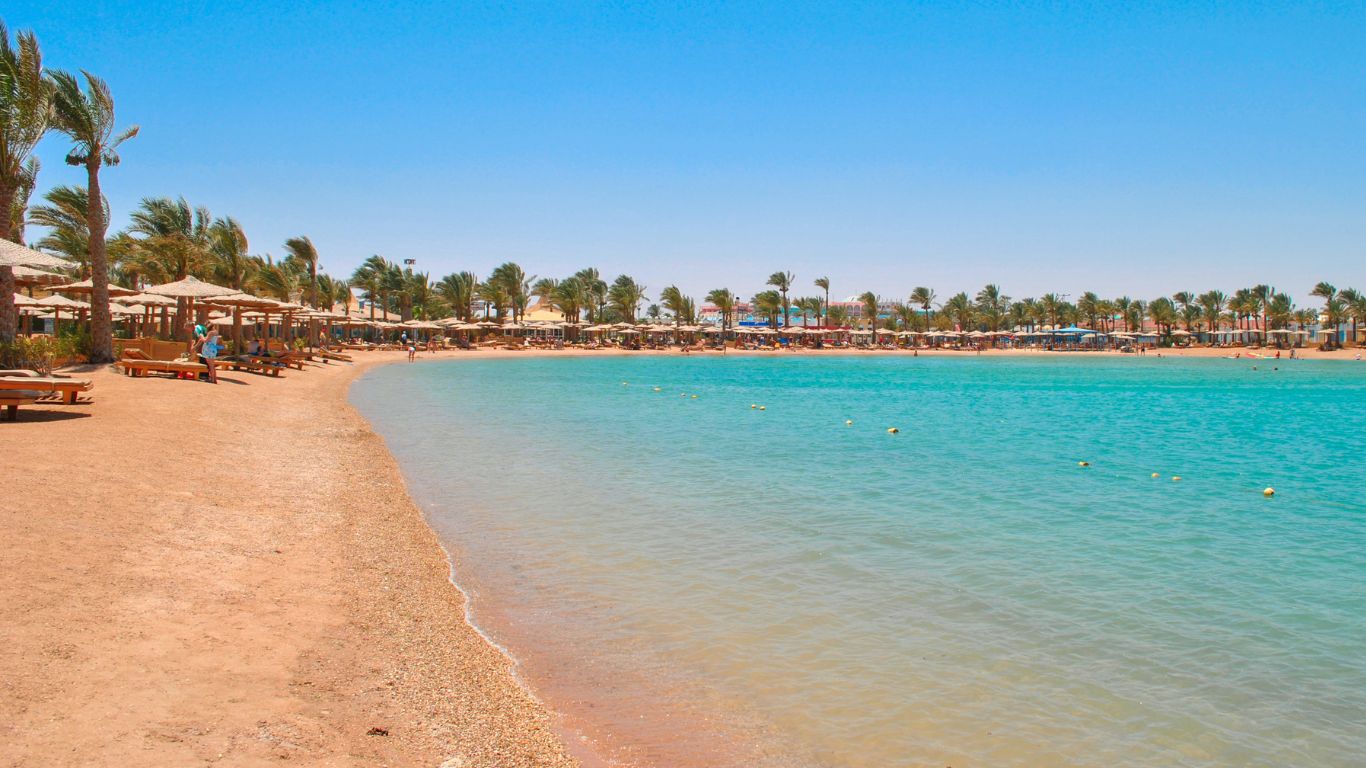
The most useful public snapshot we found is from Airbtics, which tracks listings on the big booking platforms. According to its Hurghada market page, updated in March 2026, the median active listing across 3,301 properties had an occupancy rate of 52% between February 2025 and January 2026, an average daily rate of EGP 2,786 (about £40 or $59), and annual revenue of around EGP 538,000 (about $11,000).
Read that carefully, because it is easy to misuse. It is a median of listings that were actually active, so it leaves out the owners who gave up in February. It is also gross revenue, before commission, cleaning, management, service charges and tax. And occupancy of 52% means that nearly half the year the flat sat empty, which is exactly why the seasonal pattern matters.
Airbtics also publishes a twelve-month seasonality chart for the city, but it gives no month-by-month figures we can quote, so we will not pretend otherwise. What follows is our own rough shape of a Hurghada year, labelled as an illustration rather than a dataset.
The shape of a Hurghada year
Think of the calendar in three bands. The first is the peak: Christmas and New Year, the February half-term and Easter, when northern Europeans are desperate for sunshine and will pay a premium to get it. The second is the long, comfortable shoulder, roughly October to April outside those peaks, when the weather is lovely and bookings are steady. The third is the low band, mostly the hottest part of summer, when European demand drops and you depend on Egyptian, Gulf and some Eastern European guests. Ask any local manager how their last three Augusts went before you build a spreadsheet around it.
The point is that a holiday let does not earn a twelfth of its income each month. It earns a big chunk in a few weeks, a decent amount in many more, and little in some. That is fine if you plan for it. It is painful if you were counting on the booking app to cover a mortgage-style monthly payment, such as an off-plan instalment. Our off-plan explainer covers why those instalments never take a summer break.
The break-even maths (don't skip this bit)
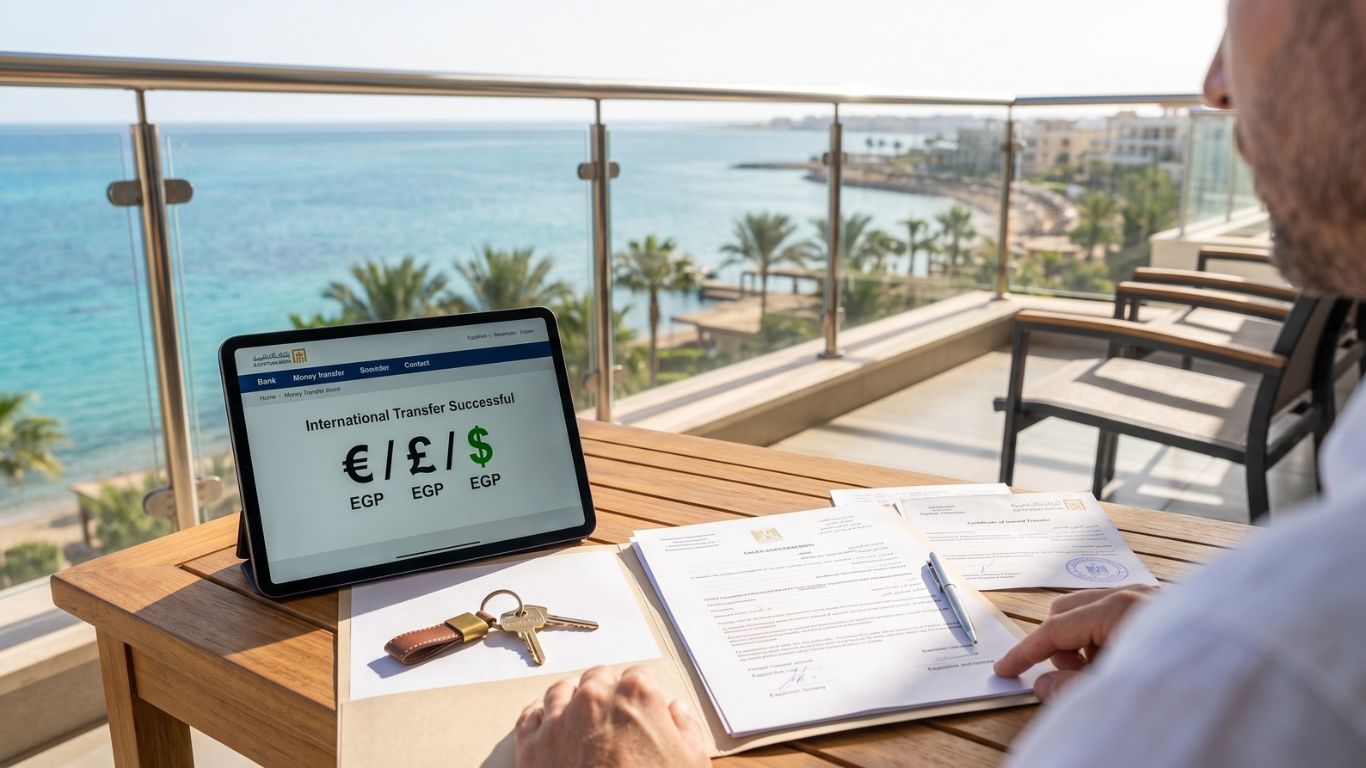
Here is a worked example. It is illustrative, with assumptions that are ours, not published figures. We use the same flat as in our yield reality check: a two-bedroom flat bought for EGP 3,000,000 (about £43,200, €51,000 or $57,300 at 1 EGP = 0.0144 GBP, 0.0170 EUR, 0.0191 USD on 7 October 2026).
For the holiday let, we assume an average nightly rate of EGP 2,800 over the year (close to the Airbtics median), a 3% platform fee, 20% for a property manager and EGP 180 for cleaning each occupied night. On top of that sit the costs that arrive whether or not anyone sleeps there: EGP 30,000 service charge, EGP 24,000 utilities, EGP 15,000 repairs and insurance and EGP 6,000 property tax, so EGP 75,000 a year in total. Every occupied night therefore leaves you EGP 1,976 after variable costs, and the fixed EGP 75,000 comes off at the end. Income tax is not included.
For the long let, we use the figure from our yield article: a net of about EGP 126,000 a year (4.2%, roughly £1,810, €2,140 or $2,410), after the owner’s usual costs (we assume the tenant pays the utilities).
Occupancy
Nights
Holiday let net (EGP)
Net yield
Net in £
25%
91
104,816
3.5%
£1,510
30%
110
142,360
4.7%
£2,050
35%
128
177,928
5.9%
£2,560
45%
164
249,064
8.3%
£3,590
52% (Airbtics median)
190
300,440
10.0%
£4,330
60%
219
357,744
11.9%
£5,150
Look at where the long let (EGP 126,000) sits in that table: the break-even is around 100 nights a year, or roughly 28% occupancy. Below that, the holiday let loses to a tenant who simply pays the rent. Above it, every extra week adds about EGP 13,800 to your net, and the gap widens quickly.
There is also a useful link back to our earlier yield article. Its "realistic year" of about 6% corresponds to roughly 130 nights, or 35% occupancy. The 52% median is higher because it covers active, listed properties that are usually well located and professionally run. If your flat is a long walk from the beach, with no photos worth the name, assume the lower end.
Guests versus tenants: the risks nobody photographs
On paper, a holiday let wins above 30% occupancy. In practice you should price the risks, because they are real.
Wear and tear. A holiday flat is used by a different household every few days, each of whom treats the sofa as a rental sofa. Expect to replace linen, small appliances and the odd lamp far more often than a tenant would. We budgeted EGP 15,000 for repairs and insurance, but a well-used flat in a busy year can eat more.
Reviews. One bad week of cleaning, a noisy neighbour or a broken air-conditioner can drop you from 4.9 to 4.5 stars, and bookings follow. The business is reputational in a way a tenancy never is.
Demand shocks. Tourism is wonderful until something happens elsewhere. According to UN Tourism's September 2026 barometer, reported by Ahram Online, Egypt received 3% more international visitors in the first half of 2026 than a year earlier, but the second quarter was down 7%, while the wider Middle East fell 22%. One strong quarter followed by a weaker one is a perfectly normal pattern, and a nightly-rate owner feels it within weeks. A tenant on a twelve-month contract does not.
Tenant risk. The long let has its own nightmares: a tenant who stops paying, a handover that goes badly, a contract that was vague about what happens next. The cure is dull but effective: a written contract, a security deposit, an inventory with photos and a clear notice period. A decent agent costs much less than a dispute.
The rules you need to check before listing
Egypt has been formalising short-term accommodation. According to Al Tamimi & Company's February 2026 briefing on the holiday homes regime, Decree No. 209 of 2025 requires operators of furnished short-term units in designated tourist areas or distinguished compounds to obtain a Touristic Eligibility Certificate from the Ministry of Tourism and Antiquities, meet minimum standards such as bilingual signage and a working lift in buildings with upper floors, and register guests through the ministry's online system.
The briefing does not spell out penalties, and we are not lawyers, so we will not guess. What we can say is practical: before you list, ask your compound or developer what its own rules on nightly rentals are, and ask an Egyptian lawyer whether your unit needs a licence. Checking costs a conversation. Skipping the check can cost your listing.
Tax deserves the same treatment. The income tax in our worked example is left out on purpose, because we have not verified whether short lets are assessed the same way as long lets. An Egyptian accountant can answer that in one meeting, and it is worth doing before you commit.
Who should run it, and how
The third decision, after "holiday or long" and "licensed or not", is "who actually does the work?" There are three realistic routes.
Self-managed. You keep the 20% manager's fee, but you also become the person who answers the guest who cannot find the door at 1am. This works if you live in Hurghada, or if you have a trusted housekeeper and a very patient phone.
Local manager. The 20% in our example buys you check-ins, cleaning, pricing and problem-solving. Quality varies, so ask for references and for the manager's own occupancy numbers, not just the pretty ones.
Resort or hotel-managed programmes. Some developments run a rental programme for owners. You get less control and usually fewer nights of personal use, but also fewer surprises. It is worth comparing terms in the Sahl Hasheesh developments and the El Gouna listings, where on-site management is more common than in a standalone block.
So which one is for you?
Choose the long let if you live abroad and want something close to hands-free, if your flat is a bit outside the buzz, or if the income covers a fixed commitment and you cannot afford a slow July. Its 4.2% net is not thrilling, but it is on time and it is quiet.
Choose the holiday let if the flat is walkable to the beach or the marina, you or a manager can keep it spotless, and you can live with months of uneven income. Above roughly 30% occupancy, the arithmetic is on your side, and at the 52% median it can more than double the long let.
Many owners end up with a hybrid: nightly bookings through the winter and spring peaks, then a six-month seasonal tenant, or a quiet owner's stay, through the hot months. Is it a little more admin? Yes. Does it smooth the cash flow and dodge the worst of the low band? Also yes. If you are still deciding what to buy, filter the holiday rentals and Hurghada properties on our site by walking distance to the sea. It will do more for your occupancy than any pricing tool.
Whichever route you pick, write down your own numbers before you sign anything. Take the break-even table above, swap in the price of your flat, and be honest about how many nights you can fill. Then browse the properties for sale, pick one that makes the maths work, and let the Red Sea do the rest of the selling.