Absentee Property Owner Guide | Hurghada & Red Sea
A practical guide for overseas owners of property in Hurghada and the Red Sea, covering key holders, caretakers, management fees, summer heat, air conditioning, bills, rentals and remote property care.
It is a damp Tuesday in Leeds. You are queuing for a parcel you did not really need when a thought arrives, uninvited and rather rude: who has the key to the flat in Hurghada? The answer, as it turns out, is "a man called Mahmoud, probably, unless it's his cousin". Welcome to the glorious, slightly nerve-racking business of owning a holiday home in a country you do not live in.
The good news is that this is a solved problem. Thousands of people own a place on the Red Sea and live a thousand miles away, and most of them sleep perfectly well. The bad news is that "solved" does not mean "automatic". An empty flat in a hot, salty climate needs a system: someone to hold the keys, someone to look in, someone to pay the bills, and a plan for the months when the sun is, shall we say, enthusiastic. This guide walks through all of it, with real numbers where we could find them and honest shrugs where we could not.
The three jobs your flat needs doing while you are away
Strip away the jargon and "property management" is three separate jobs wearing one hat. Knowing which one you actually need saves you money.
Job one: being there. Someone has to hold a set of keys, open the door for the plumber, let in the electrician, and notice when something drips. This is the caretaker role. It is cheap, local and wildly underrated.
Job two: running the money. Service charges, utilities, the annual property tax, and (if you let the flat) collecting rent or booking income. This is admin, and it is the job most owners abroad quietly neglect until a polite but firm letter arrives.
Job three: running the guests. Listings, bookings, check-ins, cleaning between stays, laundry, complaints at midnight. This is the full hospitality service, and it is the one that costs real money. If you are not letting the flat, you do not need it at all. If you are, it is usually worth every piastre, as we explain in our guide to holiday rentals on the Red Sea.
Keys: who holds them and how not to regret it
Keys sound trivial until you picture a burst flexi-hose and a locked door. A few habits make life calmer.
First, decide on exactly two key holders: one primary (your manager, caretaker or a trusted friend) and one backup who lives nearby. Not five. Every extra copy is another place for the key to wander off to.
Second, put the arrangement in writing. A short message or email saying who holds the keys, who is allowed to enter, and under what circumstances takes five minutes and prevents very awkward conversations later. If you use a smart lock with changeable codes, even better: you can revoke access from your phone in London without a flight.
Third, check the compound's own rules. Many gated communities have security desks that log visitors and may need your written permission before letting a contractor or cleaner through the gate. Ask the compound office once, in advance, and keep the answer.
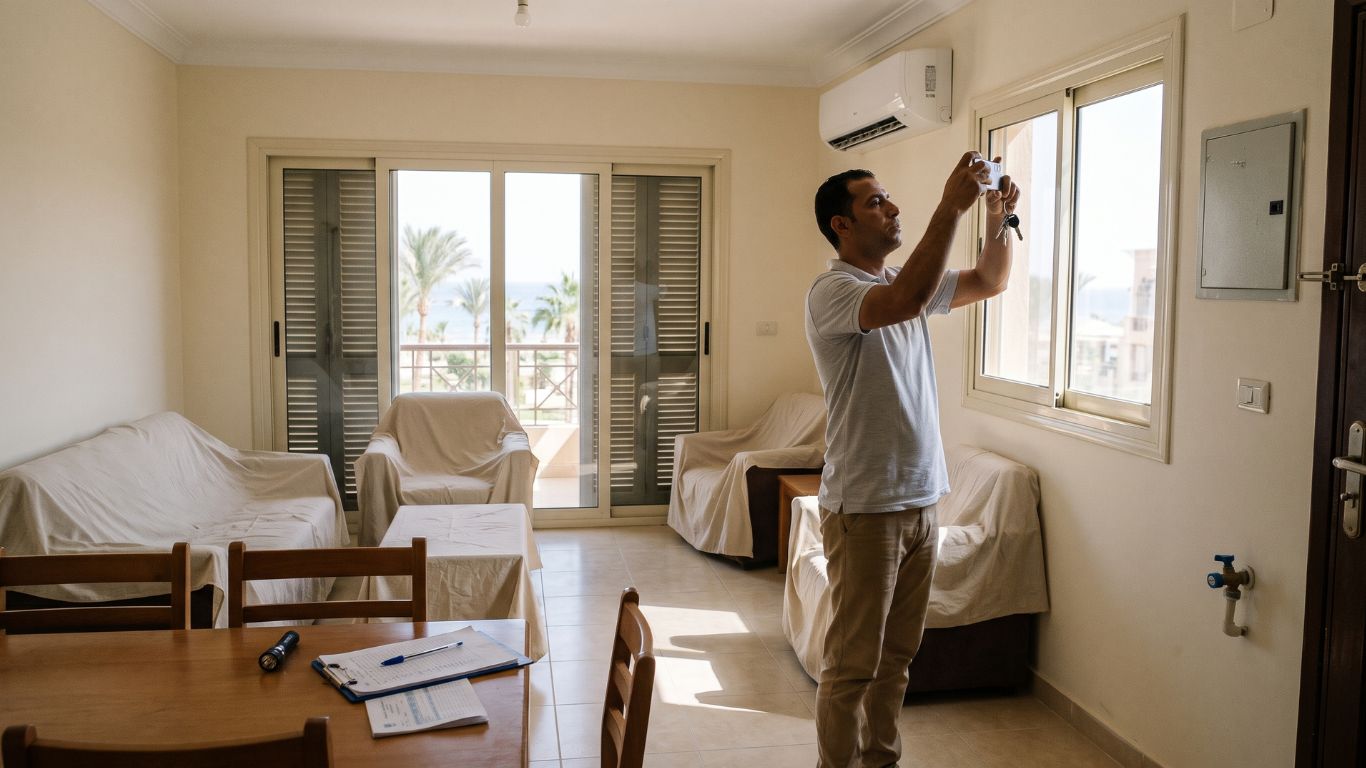
Finally, remember that your meter readings, your water shut-off valve and your fuse board are all things somebody must be able to reach. Walk your caretaker through them on your next visit, and take a photo of each. You will thank yourself during the first leak.
Do you need a manager? The honest sorting hat
Roughly speaking, owners fall into three camps.
The "just in case" owner. You use the flat a few weeks a year and never let it out. You need a caretaker, not a manager. A trusted person who visits every two or three weeks, runs the taps, checks the air conditioning and reports with photos is plenty. Compounds often have staff who do exactly this for a modest fee, so ask the compound office first.
The "long-let" owner. You rent to a tenant for a year. Here a management company handles the tenant, the contract and repairs. According to Global Investments' guide to finding a property manager in Egypt, updated in June 2026, residential management is typically 5 to 10 percent of monthly rent, plus a tenant-finding fee of around one month's rent, with maintenance charged at cost.
The "holiday-let" owner. You rent short stays, so someone needs to be on the ground constantly. The same guide puts management commission for tourist rentals on the Red Sea at typically 20 to 35 percent of gross revenue, with cleaning either included or billed per stay and caretaker or cleaner wages often on top. In El Gouna's developer rental pool the operator's commission is typically 30 to 40 percent.
Not everybody agrees on the number, which tells you something useful. A separate Global Investments guide to holiday-home running costs in El Gouna uses a management fee of 15 to 25 percent of gross revenue. Both pages carry the same June 2026 update date, so the gap is real: the percentage depends on what is bundled in, which is why the next section matters.
What a manager costs, in plain numbers
Here is the picture from the sources we could verify. Treat these as ranges to negotiate around, not price lists.
Cost
Typical range
Source
Long-let management
5 to 10% of monthly rent, plus about one month's rent to find a tenant
Global Investments, June 2026
Holiday-let management (Red Sea)
20 to 35% of gross revenue
Global Investments, June 2026
El Gouna rental pool
30 to 40% of booking revenue
Global Investments, June 2026
El Gouna holiday-let management (second guide)
15 to 25% of gross revenue
Global Investments, June 2026
El Gouna community fee
USD 2,000 to 5,000 a year
Global Investments, June 2026
Annual maintenance, well-kept chalet
USD 1,500 to 4,000 a year
Global Investments, June 2026
Compound service charge (Egypt-wide, marketing blog)
about 2 to 5% of the unit price a year
Nawy, 15 October 2026
Two honest notes. The Nawy figures come from a developer-side marketing blog with no sources for its percentages, and the same post says buyers also pay a one-off deposit of roughly 8 to 10 percent of the price into a sinking fund, so confirm the exact amounts in your own contract. And as our look at rental yields shows, the cost of management is exactly why a headline yield and the money that lands in your bank account are two different things. Our platform average of 12.4 percent net is the upper end of the range, not the promise.
A quick worked example, with made-up round numbers. Say your flat earns EGP 300,000 in gross booking income over a year. At a 25 percent commission the manager keeps EGP 75,000. At 35 percent it is EGP 105,000. That EGP 30,000 gap is the price of a very good caretaker for a year, which is why the contract wording on what the percentage includes matters more than the percentage itself.
Ten questions to ask before you sign anyone
Egypt has no central licensing or accreditation for residential property managers, a point the Global Investments guide makes bluntly, so the due diligence is yours. Their list of questions is sensible, and we have added a few of our own.
Ask how many properties they manage and how many belong to overseas owners. Ask for two references from overseas owners and actually call them. Ask whether the fee is fully inclusive or whether cleaning, laundry and staff come on top. Ask how rental income reaches you: currency, mechanism, frequency. Ask what the monthly report contains. Ask what repairs they can authorise without calling you, and at what amount they must ask first. Ask how they handle an air-conditioning failure in August, because it will happen. Ask whether they can help with Egyptian income tax filing or at least refer an accountant. Ask how they communicate with owners abroad (WhatsApp with photos is the gold standard). And ask what the termination terms are, because leaving a bad manager should not cost more than keeping one.
If you plan to let short stays, add one more: does the unit hold the right licence? Under Holiday Homes Decree No. 209 of 2025, as summarised by Al Tamimi & Company in February 2026, furnished short-term units in designated tourist areas or distinguished compounds need a Touristic Eligibility Certificate from the Ministry of Tourism and Antiquities, and guests must be registered through the ministry's online system. A good manager will know this by heart. A manager who shrugs is telling you something.
The summer heat problem (and why your air conditioning should stay on)
Now to the part that surprises first-time owners. The Red Sea in July and August is not a gentle climate for an empty flat. Weather2Travel's Hurghada climate table lists average daytime highs of around 34 degrees in July and August, with nights barely dipping below 25. Other sources run hotter: Global Investments describes June to September in El Gouna as very hot, at 38 to 42 degrees, and says most European visitors do not travel then.
The instinct of the frugal owner is to switch everything off and save electricity. The instinct is understandable and, in a humid, salty place, usually wrong. A closed flat with no air movement builds up heat and moisture. Khaleej Times reported in August 2026, in a piece about Dubai homes left empty over summer, that closed homes can develop bad smells, damp patches, insects and mould around vents and walls, and that moisture can collect inside air-conditioning units that stay off for weeks. It quotes advice to run the air conditioning at about 26 to 28 degrees in fan or auto mode during long absences, and to keep indoor humidity below 60 percent. Dubai is not the Red Sea, but the physics of a hot, humid coast is much the same, so we think the advice travels well.
A sensible summer routine, which is our advice rather than a rule, looks like this:
Have the air conditioning serviced and the filters cleaned before the hottest months, not during them. Global Investments notes that hot climates mean more frequent servicing.
Leave one or two units running at a gentle setting, or ask your caretaker to switch them on for a few hours twice a week, rather than coming back to a flat that smells like an old gym bag.
Run every tap and flush every toilet on each visit so the drains stay wet and the smells stay out.
Empty the fridge, leave the door slightly open, and take anything perishable with you.
Move soft furnishings, books and electronics away from outside walls and keep wardrobes slightly open.
Close the curtains or shutters on sun-facing windows so the flat does not turn into a greenhouse.
Ask for a photo report every two or three weeks. Not a paragraph, just ten photos and a thumbs-up.
Also bear in mind that salt air is hard on metal, hinges, balcony furniture and anything with a motor. A quick annual check by a handyman costs far less than replacing a rusted balcony door.
Paying the bills from a long way away
The dullest part of absentee ownership is also the one that causes the most grief. Service charges, utilities and property tax all keep arriving whether or not you are in the country.
Start with the service charge: ask the compound exactly how and when it is billed, and whether they accept payment from abroad or need a local representative. Next, set up the utilities in your name if you can, with a local contact who can sort out a disputed bill. For property tax, our guide to running costs and tax in Egypt covers the basics, and the pattern is the same: someone local must be authorised to act for you.
One more practical point from the same Global Investments guide: rental income and fees are primarily in Egyptian pounds, so you carry some currency exposure, and foreign-currency transfer rules can delay getting rental income out of the country. A separate local accountant is also usually needed for the annual Egyptian tax filing, because the manager may not do it. Build those two things into your plan from the beginning rather than discovering them in December.
A one-page absentee owner checklist
Two key holders, in writing, with the compound office informed.
A caretaker or manager chosen for the job you actually need done.
A contract that spells out what the fee includes and what needs your approval.
Photos of the water valve, fuse board and meters, shared with your caretaker.
Air conditioning serviced before summer and left on a gentle setting or run regularly.
A local accountant, a local bank contact and a clear route for rental income to reach you.
A short, regular photo report as the price of your peace of mind.
A word for owners who would like to let the flat
If you have read this far and thought "I would quite like someone else to worry about all this", you are in good company. Many owners abroad list their flats for holiday or long-term rent precisely so that a good local team handles the keys, the cleaning and the guests while the flat earns something during the months you are not there.
That is also where our platform comes in. Red Sea Listings is a marketplace where verified agents and owners list property, and buyers and renters use it for free. If you own a place in Hurghada, Sahl Hasheesh or El Gouna and want it looked after properly, start by browsing homes in Hurghada, apartments in Sahl Hasheesh and villas in El Gouna to see how comparable places are presented, or get in touch to list yours.
Your flat should be the thing you look forward to seeing, not the thing that wakes you at 3am in Leeds. Find your Mahmoud, put him in writing, switch the air conditioning to a gentle hum, and go and queue for that parcel in peace.