Can Foreigners Get a Mortgage in Egypt? Finance Options Explained
A practical guide to property finance in Egypt for foreign buyers. Compare bank mortgages, developer instalment plans, cash purchases and borrowing against assets at home, with the key costs, risks and questions to check before buying.
Picture the scene. You have found the flat: two bedrooms, sea view, a pool that looks suspiciously like the brochure. You turn to the agent and ask the question every sensible buyer asks: "Can I get a mortgage?" The agent smiles the smile of a man who has been asked this before and says, "Of course, no problem." You do not feel reassured. You feel like you have just been sold a very nice umbrella in a very sunny place.
So let's do this properly. The honest answer is that the word "mortgage" means something quite different in Egypt from what it means in Leeds, Lyon or Leipzig. For most foreign buyers, the thing that does the job of a mortgage is not a bank at all. Let's walk through what is actually on offer, what it really costs, and how to pick the route that suits you.
The short answer
If you live abroad, a standard Egyptian bank mortgage is hard to get and, for most people, not worth waiting for. According to Global Investments' property finance guide (last updated 13 June 2026), "non-resident foreigners typically cannot access standard mortgage products", and most overseas buyers either pay cash or use a developer payment plan. The practical options come down to three: a developer instalment plan, borrowing against something you own back home, or cash. A bank mortgage sits in a fourth box that mostly opens for people who actually live in Egypt.
What the banks do (and who they do it for)
The mortgage market is regulated by the Mortgage Finance Authority, and Global Investments names National Bank of Egypt, Banque Misr and QNB Al Ahli among the banks offering residential mortgages. Those products are built for Egyptian nationals and residents, though, not for someone logging in from Manchester on a Sunday evening.
Here is where it gets messy, because the sources do not agree. Expat Focus says that "Egypt offers mortgages to both residents and foreign nationals", with eligibility and terms varying by lender; foreign applicants may need proof of stable income, a valid residency or visa and a good credit history, and banks may ask for a down payment of 20% to 40% (the page was published in November 2024 and does not name the banks). Wise's guide to buying property in Egypt says some lenders, QNB among them, do lend to foreigners, but "not all do", and that a residency visa or proof of address in Egypt is likely to be a key requirement.
Put those together and you get a fairly consistent picture: if you are resident in Egypt, with local income and paperwork, a bank loan may be on the table. If you are living in Germany and want a holiday flat, it almost certainly is not. We did not find any published figures for loan-to-value, interest rate or loan term for non-resident buyers, and we are not going to invent them. If an agent quotes you a rate, ask for it in writing, from the bank, in your name.
Why interest rates make banks the hard route
Here is the bit that explains why developers, not banks, built Egypt's property market. In August 2026 the Central Bank of Egypt held rates for the fourth meeting running, according to Enterprise: the overnight deposit rate stood at 19.0% and the overnight lending rate at 20.0%, with urban inflation at 14.9% in July. When the central bank charges banks around 20% to borrow, a 25-year mortgage for a buyer is a hard sell.
The same outlet reported in February 2026 that the central bank made 725 basis points of cuts in 2025, and that sources described the mortgage market as previously "effectively paralyzed" by high rates. Developers, meanwhile, ended up carrying eight to ten year instalment plans on their own balance sheets. One developer quoted by Enterprise called this "a necessity, not a choice." Lower rates are slowly pushing financing back towards banks, with step-up mortgages and longer terms appearing, but that is a story about Egyptian residents, and it is still unfolding.
The developer plan: the real mortgage
Global Investments describes the usual shape: a down payment of 5% to 20% at booking, then annual or quarterly instalments over four to ten years, with some premium developers stretching to twelve. Our own platform reflects the same pattern, with plenty of master developments around new developments offering 10% down and five to seven years to pay. If you want the full mechanics, our guide to off-plan buying (EN-2) walks through a worked example.
Here is what it looks like with round numbers. These are illustrative figures, not an offer from anyone. Take a flat priced at EGP 3,000,000 (about £41,800 or €49,800 at recent rates). With 10% down and the rest over seven years:
Item | EGP | Roughly in GBP |
|---|---|---|
Price | 3,000,000 | £41,800 |
Down payment (10%) | 300,000 | £4,180 |
Balance | 2,700,000 | £37,640 |
Monthly instalment (84 payments) | 32,143 | £448 |
That is a monthly payment closer to a decent phone contract plus a gym membership than to a London rent. No credit scoring against your British salary, no valuation by a bank surveyor, and no stack of Egyptian income paperwork. This is why most of the people who write to us about "mortgages" end up looking at off-plan developments in Sahl Hasheesh or similar.
Is "0% interest" really 0%?
This is the question worth spending five minutes on. Global Investments points out that many plans are nominally interest-free or low-interest, with the financing cost built into the unit price, so a "0% interest" plan can still carry an implied rate if the cash discount is large.
Here is how to check it, using our own made-up numbers. Suppose the instalment price is EGP 3,000,000 as above, but the developer would take EGP 2,550,000 for cash today. That is a 15% discount for paying upfront. If you pay the 10% deposit (EGP 300,000) and then 84 monthly instalments of EGP 32,143, you are effectively borrowing EGP 2,250,000 and paying back EGP 2,700,000. That works out at about 5.3% a year. If the cash price were EGP 2,400,000 (a 20% discount), the same plan implies about 7.4% a year. These are our own calculations, and your plan will differ, but the method is the same: ask for the cash price, then do the sum.
The interesting twist: with Egyptian policy rates around 19% to 20%, an implied 5% to 7% on pound instalments does not look expensive on paper. But one thing matters enormously, and that is which currency the instalments are fixed in. If they are fixed in Egyptian pounds, inflation (14.9% in July, with the central bank forecasting a 16.6% average for 2026/27) steadily shrinks the real cost, while a weaker pound shrinks it further in euro or sterling terms. If they are fixed in a foreign currency, none of that applies. Ask which one it is, in writing.
The fine print nobody puts on the brochure
Instalment plans are friendly, but they are not risk-free. Global Investments is blunt that developer insolvency and project delays are "not uncommon", and that buyers typically do not receive the title deed until all instalments are paid. The Real Estate Registry's own guidance makes the same point from another angle: the property is not legally yours until it is registered. So before you sign:
Check the developer is real, registered and has delivered projects before (our anti-scam checklist, EN-17, shows how).
Ask how delays are handled and whether the plan pauses if the project does.
Ask whether instalments are in pounds or foreign currency, and whether the price can be revised.
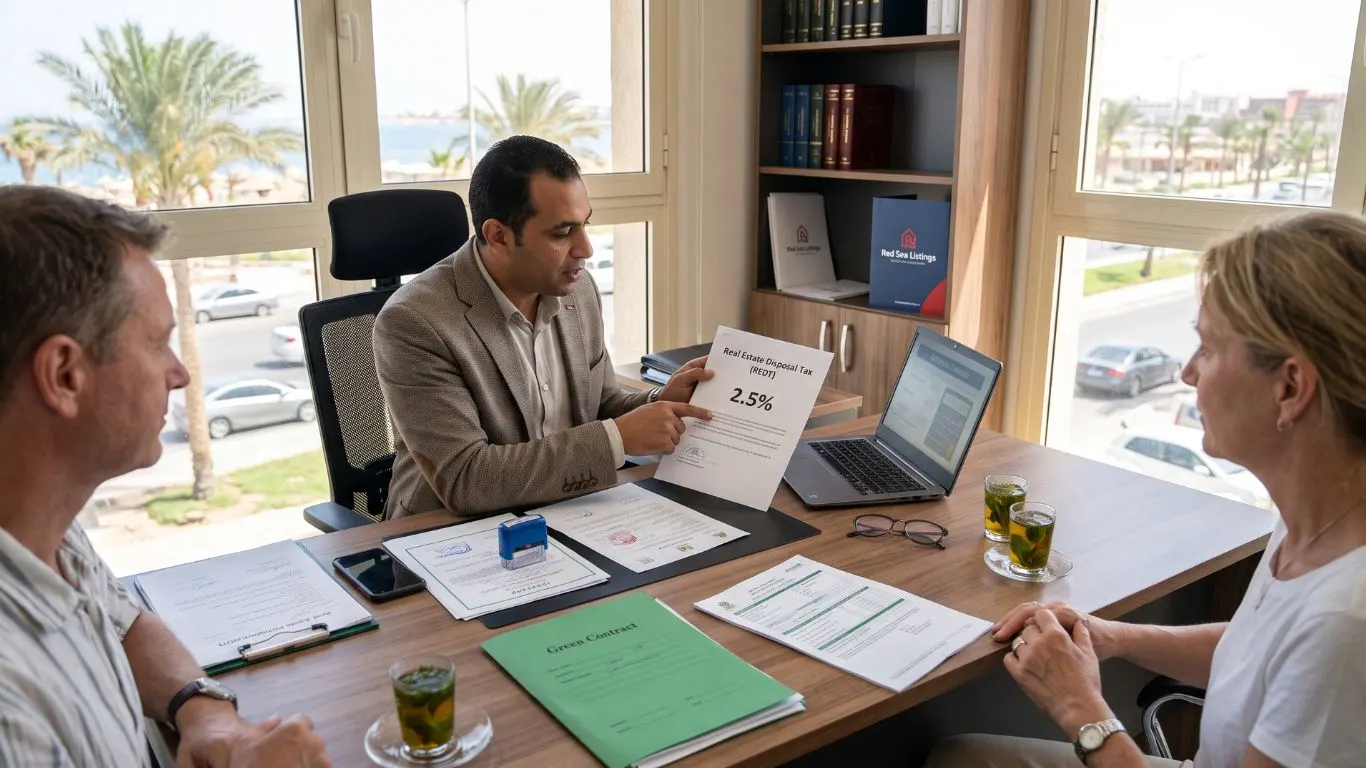
Budget for the extras. Global Investments puts total transaction costs at 5% to 8% on top of the price, including registration of about 2% to 3%, notary and legal fees and, on some new builds, 14% VAT.
Pay by bank transfer, never cash, and keep every receipt. The Real Estate Registry's guide for foreign buyers is clear about that, and our money-transfer guide (EN-9) covers the route.
Borrowing at home: the quiet favourite
If you own a home, a portfolio or a decent pension pot elsewhere, you may not need Egypt's banks at all. Global Investments lists three offshore routes people use to fund Egyptian purchases: equity release on property in the buyer's home country, Lombard lending against a securities portfolio through a private bank, and credit facilities from banks in the UAE or the Gulf. Wise likewise mentions refinancing a UK property to release funds.
The appeal is obvious. Your home bank knows you, speaks your language, and charges you in your own currency. The catch is just as obvious: your own home becomes the collateral for a flat in another country, so a sudden wobble in the market can land on your doorstep. That is our view, not a sourced rule, but we would want the rental income to cover the repayments with room to spare before borrowing against the family home. Our rental yield reality check (EN-3) shows how to run those numbers honestly.
Four routes side by side
Route | Who it suits | Main upside | Main catch |
|---|---|---|---|
Developer instalment plan | Most overseas buyers | Low deposit, no bank approval | Delay risk; title deed usually after final instalment |
Egyptian bank mortgage | Residents with local income | Finished, registered property | Tough for non-residents; terms vary by lender |
Borrowing against assets at home | Owners of property or investments | Familiar lender and currency | Your own assets are on the line |
Cash | Investors with funds ready | Often a cash discount, simplest deal | Money tied up in one asset |
Seven questions to ask before you pick
What is the cash price, and what is the instalment price?
Are the instalments in pounds or foreign currency, and are they fixed?
When do I get the title deed, and what happens if the project is delayed?
What are the registration, maintenance and service charge costs on top?
Can I sell or assign the unit before I have finished paying?
If I borrow at home, would the rent cover the payments in a bad year?
Has an independent Egyptian lawyer read the contract? Not the seller's lawyer. Yours.
Where to start
Here is the practical bit. On Red Sea Listings, you can browse apartments in Hurghada, villas in El Gouna and homes in Sahl Hasheesh with prices shown in euros, dollars, pounds or Egyptian pounds, and every agency and developer is KYC verified. Buyers pay nothing, there is no commission from us, and you can message agents directly on WhatsApp to ask exactly the questions above. If the answer to "is the plan really interest-free?" is a nervous change of subject, you will know what to do. If it is a spreadsheet, you have probably found a good one.
Pick a development, ask for the cash price, do the sum, and then decide. The sea has waited a few million years. It can wait for you to read a payment schedule.