Sending Money to Egypt to Buy Property | Buyer Guide
A practical guide for foreign property buyers transferring money to Egypt, covering euros, pounds and dollars, international bank transfers, currency conversion, proof of funds, inward transfer certificates and the paperwork needed when you eventually sel
Everyone fusses over the flat. The sea view, the pool, whether the kitchen is big enough for more than one person and a kettle. Hardly anyone fusses over the bit that can quietly cost you thousands: how the money actually gets from your account to Egypt.
That is a shame, because the transfer is the one part of buying property on the Red Sea where a small slip is hard to undo. Send it the wrong way and you may struggle to prove where it came from. Skip one piece of paper and, years later, taking your sale proceeds home turns into a very long afternoon at a bank counter. Do it properly and it is a dull, tidy process, which is exactly what you want from anything involving six figures.
So here is the dull, tidy version, with a few jokes to keep you awake. It sits nicely alongside our guide to buying property in Egypt as a foreigner, and it picks up where that one stops: at the moment you have to move actual money.
The one rule that matters: foreign currency, from abroad, through a bank
If you remember nothing else, remember this. According to The Rio Times (21 September 2026), since 26 March 2024 foreign buyers have had to show that the price was paid from abroad in foreign currency, a requirement that came from Circular 41, issued the day before by the real-estate registration authority. The money has to land in a bank authorised by the Central Bank of Egypt.
The same report adds a detail that trips people up. If your contract is priced in Egyptian pounds, you still pay in foreign currency, converted at the prevailing rate. If the contract is priced in a foreign currency, the Central Bank has to approve the sale first. So the price on the paper and the money in your hand do not need to match in currency, but the route they take absolutely does.
It is not a new idea, either. An Amwal Al Ghad opinion piece from May 2024 described the Real Estate and Documentation Authority circular as requiring that all payments by foreigners go through authorised channels, meaning banks, and said registry offices must follow its procedures before registering any contract. In plain English: no bank trail, no registration. And, as the Real Estate Registry's own guide puts it, a property is not truly yours until it is registered.
Euros, pounds or dollars? Pick the one you already have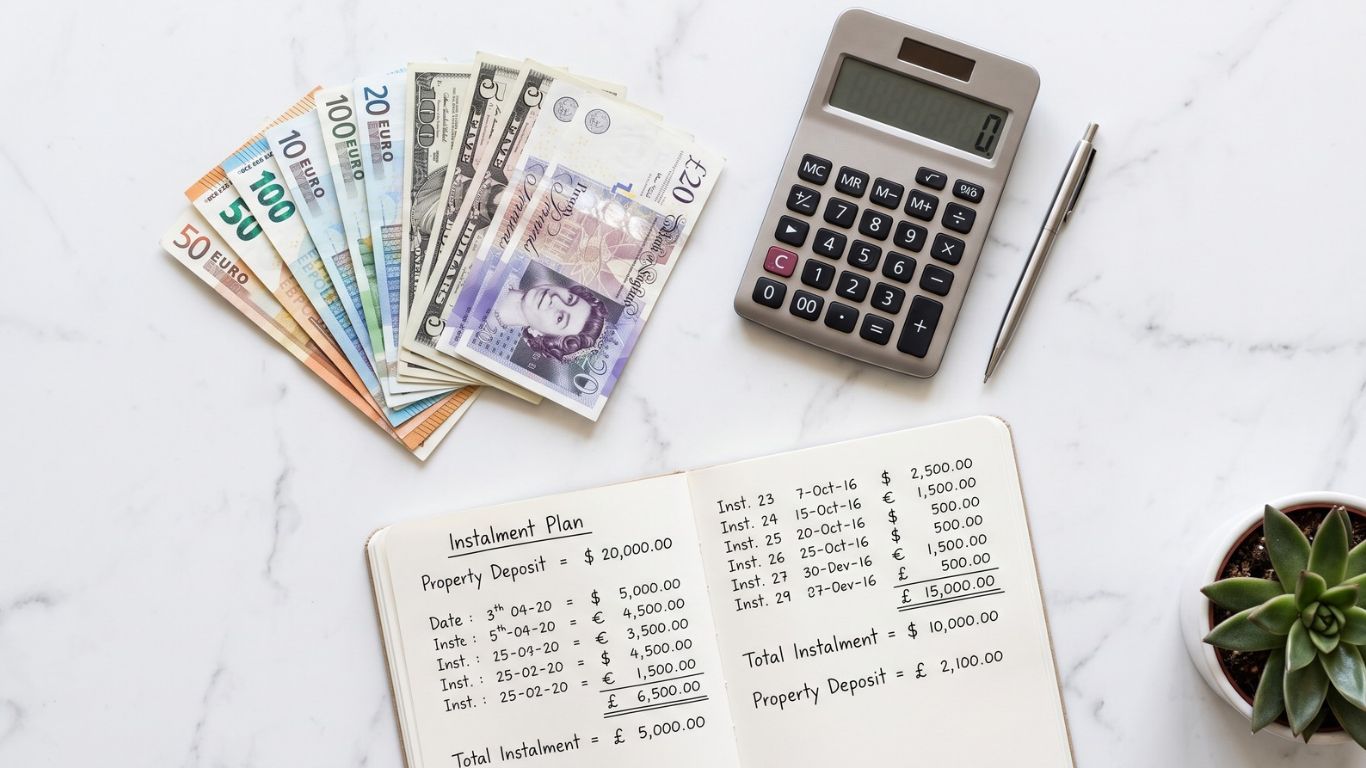
Here is the good news. You do not need to become a currency trader. Whichever of the big three you hold, the principle is the same: send it from your account abroad, let the Egyptian bank convert it, and keep the paperwork that says so. Which one makes sense is mostly a question of which one you would otherwise be converting anyway, because every extra conversion is another place for a margin to hide.
To see what we are talking about, here is a flat priced at EGP 3,000,000 (a very ordinary one-bedroom in the Hurghada area) at the rates quoted on 30Rates on 19 October 2026, when one euro bought about EGP 60.24 and one pound about EGP 71.74. The dollar figure uses the roughly 52 pounds to the dollar The Rio Times quoted for late September.
What you pay
In EGP
In euros
In pounds
In dollars (approx.)
Whole flat
3,000,000
about 49,800
about 41,800
about 57,700
10% deposit
300,000
about 4,980
about 4,180
about 5,770
A 1% wobble in the rate
30,000
about 500
about 420
about 580
That last line is the one to stare at. A one per cent move in the exchange rate on a EGP 3m flat is roughly the price of a decent weekend in Italy. The Egyptian pound has been anything but sleepy since it was floated on 6 March 2024, and the same Rio Times piece notes how far it has moved. Which brings us to timing, but we will get there.
The transfer, step by step
This is the sequence we would follow ourselves. Treat the order as a sensible default and let your lawyer adjust it for your deal.
Agree the paperwork first. Reservation form, preliminary contract, payment schedule. The Real Estate Registry's guide says a deposit, typically 10 to 30 per cent, is paid when you sign the preliminary sales agreement. Do not wire anything on the strength of a chat on WhatsApp.
Ask who the money goes to, and check it. The developer or seller should be verifiable on the registry's own website. The account name should match the contract, not a cousin's company, not a "temporary" personal account.
Open or use an Egyptian bank account. Some buyers pay directly into the developer's bank account, others route funds via their own Egyptian account. Either way the receiving bank must be authorised by the Central Bank. Ask your lawyer which fits your contract.
Send the money by international bank transfer, in foreign currency. Put the contract number and unit number in the payment reference. Boring, and wonderfully useful later.
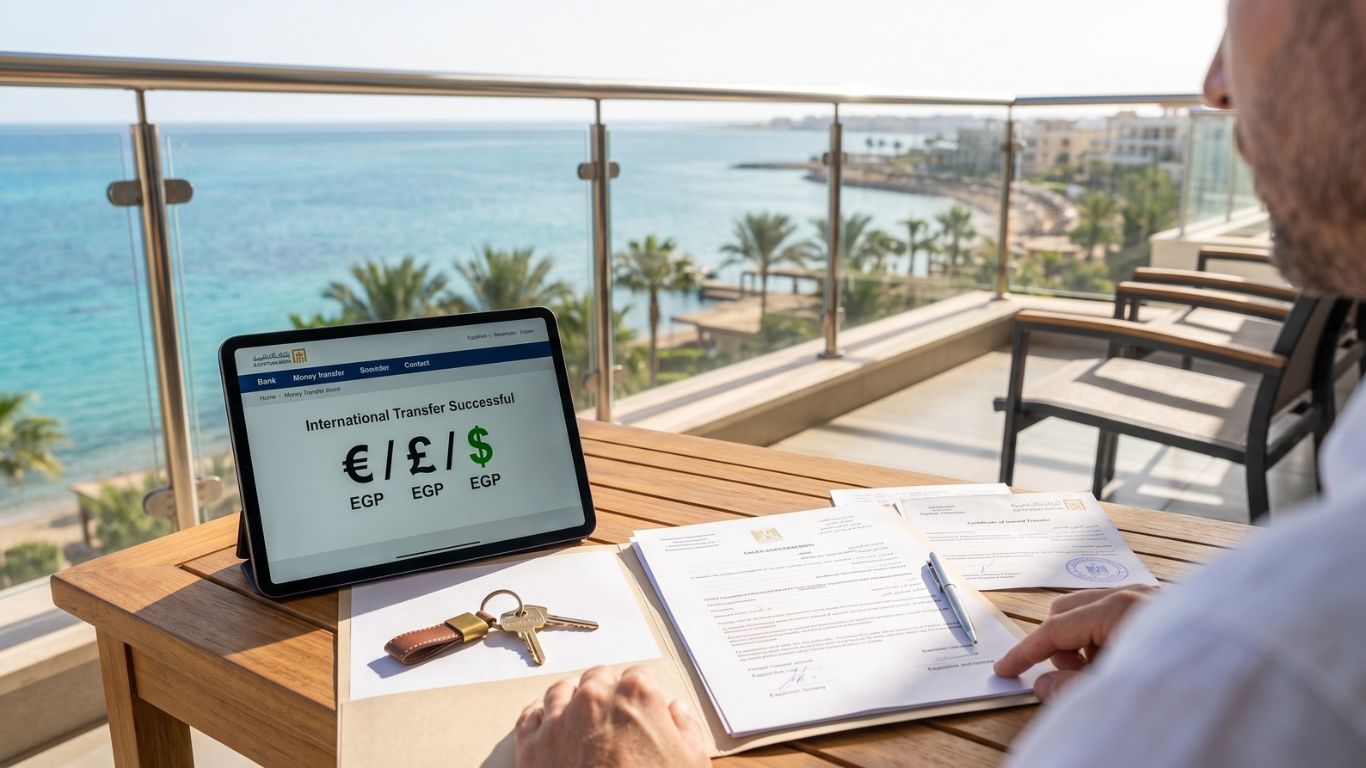
Ask for a written certificate of the inward transfer. The Rio Times tip is worth pinning to your fridge: ask your Egyptian bank for it and keep it. That certificate is the document that supports taking proceeds out again in hard currency.
Get the receipt from the seller or developer that matches the amount, date and unit. Registry guidance says to insist on bank transfers and receipts and to be wary of cash-only offers.
File everything in one folder, paper and digital. Transfer confirmations, bank certificates, exchange records, receipts, contract. Back it up somewhere you will find it in 2035.
Why the paper trail is your future exit
Most people think of the paperwork as a hoop to jump through at the start. It is better to think of it as an insurance policy you only claim on when you sell.
Egyptian law does not impose a general ban on moving legitimately held money abroad, according to a September 2026 briefing from Youssry Saleh & Partners on Mondaq. But a legal right to transfer does not oblige a bank to process a particular payment, and banks apply anti-money-laundering, due-diligence and foreign-exchange rules. The firm says four questions usually shape the file: who owns the money, where it came from, how it was taxed and why it is going overseas.
For a property sale, the documents the firm lists include purchase and sale documents, proof of ownership, records of how the buyer paid, and tax documents. It adds that one traceable bank transfer is much clearer than several cash deposits. And on the investor side, The Rio Times says Investment Law 72 of 2017 guarantees transfers abroad through registered banks, but that the guarantee depends on your paperwork. Its warning is blunt: money that entered outside the banking system may only come out in pounds, at whatever rate applies then.
Then there is tax. The same Mondaq briefing says Egypt currently applies a 2.5 per cent real-estate disposition tax to relevant transactions by non-traders, and The Rio Times describes it as charged on the whole sale price rather than on your profit. Moving the money abroad does not make the tax disappear, so sort out the tax position before you ask the bank for the transfer.
The tempting shortcut: do not
Every market has an uncle with a friend who "has a better rate". In Egypt that friend might offer to take your euros in one country and hand over pounds or a unit in another, no banks involved. It can look wonderfully efficient for about nine minutes.
The Central Bank of Egypt has warned against transfers through unauthorised channels, and the Mondaq briefing refers to penalties under banking legislation for unlicensed foreign-exchange dealing and money transfer (it gives no amounts). It also makes the point most buyers miss: informal offset arrangements leave no bank record, so later you cannot prove where the money came from. Your savings may be perfectly honest. Without a trail they still look like a puzzle.
Timing the rate without losing sleep
Nobody can predict the pound, and anybody who promises to is selling something. What you can do is manage the exposure.
Know what your contract is fixed in. If the price is in Egyptian pounds and you pay in euros, a weaker pound makes the flat cheaper for you and a stronger one makes it dearer. Ask exactly how the conversion rate is set on each payment date.
Instalments change the maths. With an off-plan payment plan, you may be converting money several times over several years. Ask whether instalments are fixed in pounds and what happens if the rate moves. Our off-plan explainer and new developments page shows how typical plans are structured.
Compare the rate you are given. Check the bank's rate against the mid-market rate on the day. A small gap is normal. A large one is an expensive habit.
Do not time the market. Looking for a bargain week is how people delay for six months and then pay more. Pick a sensible plan and stick to it.
For context on how far things have moved, our own research notes put the record low for the pound at around EGP 54.86 to the dollar in March 2026, with roughly 52 by September, citing The Rio Times. Anyone who sent their money in the dip is feeling clever. Anyone who sent in the dip and then spent three months googling is feeling thoughtful.
Red flags worth walking away from
Cash-only offers, or "bring it in a bag". The registry guidance specifically warns about cash-only deals.
A payment account that does not match the name on the contract.
Pressure to pay "today, before the price goes up" with no contract on the table.
Anyone suggesting you can skip the bank certificate because "everybody does".
A rate offered by an agent that is dramatically better than anything you can find. Maths still works in Egypt.
A request to pay in a currency other than the one the contract states, without anything in writing.
A short checklist for the day you press "send"
Signed contract in hand. Account details checked against the registry and the contract. International transfer from your own account, in foreign currency. Contract and unit number in the reference. Written certificate of inward transfer from the Egyptian bank. Receipt from the seller. Everything in one folder. That is the whole routine, and it takes a lot less time than choosing curtains.
When you are ready to see what your budget buys, browse apartments and villas in Sahl Hasheesh, flats in Hurghada, or holiday rentals if you would like to spend a few weeks there before you commit. Tell us your budget and your currency, and we will point you at listings that suit both. The sea is waiting, and the paperwork, we promise, is the easy bit.